Dear Audience,
For a year now, we have been meeting you at Zachęta. Thank you for every visit. In 2026, as before, we will present artistic projects that explore the plurality of narratives, the complexity of identity, and the dynamics of memory and forgetting. We see artists as researchers and witnesses to history, including its most recent chapters. Their perspectives make visible what often remains overlooked, yet is fundamental to a shared, civic reflection on the future. We aim to provide our audiences with access to international artistic practices and currents, while also supporting the development of local and translocal art scenes.
In 2026, the historic Mały Salon and the neighbouring ground-floor galleries will be dedicated to presentations by Karolina Wiktor, Krzysztof Gil, João Maria Gusmão, and Tobias Zielony. Karolina Wiktor reflects on language, identity, and the experience of aphasia through word-based art and visual poetry. Krzysztof Gil focuses on Roma histories, mechanisms of exclusion, racism, and work with memory and forgetting. Tobias Zielony uses photography to explore identity, migration, and life on the margins, bringing together documentary and staged approaches. João Maria Gusmão, working at the intersection of conceptual art and analogue film, draws attention to shifts in meaning within simple actions and phenomena—treating them as a kind of ontological experiment.
In the first-floor galleries, we will present, among others, solo exhibitions by Krystyna Wojtyna-Drouet, Barbara Kasten, and Susan Hiller, as well as a dialogue exhibition bringing together Alina Szapocznikow and Nairy Baghramian. Krystyna Wojtyna-Drouet, who has created over 320 textiles, worked at the very centre of avant-garde explorations of the medium. Barbara Kasten, in turn, recognised artistic textile as a structure for spatial thinking—an approach she later developed through photography and installation, where weave, transparency, and texture became key tools for working with light and space. Memory and psychology were central to Susan Hiller’s practice, in which she adopted the roles of artist, critic, and ethnologist, exploring her relationship with the world. The work of Alina Szapocznikow and Nairy Baghramian is linked by experimentation with the body—though their approaches reveal fundamental differences.
In spring, Zachęta will host a group exhibition dedicated to maturation understood as an aesthetic and socio-cultural category: a moment of intensity and experimentation, focusing on youth, unrest, and a negotiation of rules and expectations.
This year, Zachęta’s Project Room invites you to meet Agnieszka Mastalerz, Dorota Podlaska, Ana Vostruchovaite, and Łukasz Radziszewski.
At the Polish Pavilion during the 61st International Art Exhibition in Venice, you will be welcomed by a project by Bognа Burska and Daniel Kotowski, developed in collaboration with the community-based Choir in Motion. It is rooted in alternative modes of communication inspired by more-than-human life.
These are only a few of the exhibitions and initiatives we are preparing for you. Alongside them, we are also working on new publications, public programmes, and conferences, and we will be pleased to welcome you to them throughout the year.
At Zachęta, we understand inclusivity as the recognition of different ways of experiencing and engaging with art—through thought and reflection, as well as through the senses. We hope each visit becomes an invitation to attentive looking and shared conversation, where critical inquiry and aesthetic experience remain equally present.
See you at Zachęta!
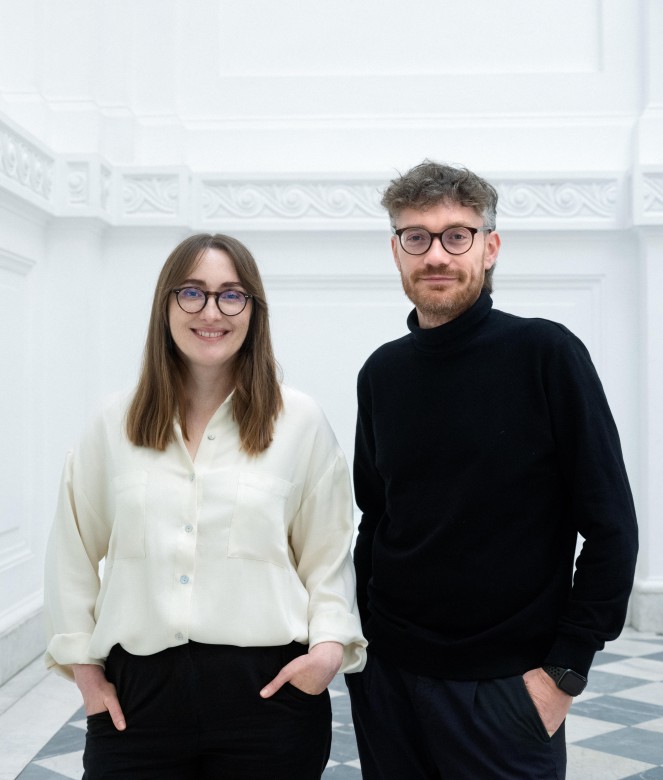
Agnieszka Pindera and Łukasz Adamski